

Abstract
Getting clean, high-quality nucleic acid out of a sample is one of the most important steps in any molecular biology experiment. But it is not always easy. Working with blood, bacteria, or plants, there are a lot of things that can go wrong like protein contamination, low yield, or degraded nucleic acid. Scientists have found a simple and affordable solution using an everyday material like cellulose paper. By dipping a small cellulose strip into a prepared sample, washing it briefly, and placing it into a testing solution, DNA and RNA can be quickly and effectively purified. The whole process takes less than 30 seconds and delivers reliable results. In this era of modern technology there are now a range of smart, efficient ways to purify nucleic acid depending on your needs.
Introduction
Different sample types like blood, plant tissue, or cultured cells come with their own set of complications, and depending on the process or the experiment, the desired purity of nucleic acid will vary. That is why choosing the right system for nucleic acid isolation is important. In this article we are going to understand where and how innovation took the lead and developed a simple yet effective system to extract nucleic acids using cellulose paper. This method is not just costly also it removes the need for expensive tools, power sources, or advanced training.
Content
The Dipstick System Based on Cellulose
Researchers discovered that untreated cellulose can rapidly capture DNA or RNA via simple immersion in crude lysate. Surprisingly, even without chemical treatment, cellulose retained enough nucleic acid to allow efficient amplification, while impurities were removed by a brief wash step.
a small cellulose binding region attached to a handle treated with wax. This dipstick is transferred through three solutions lysate, wash buffer, and the amplification reaction, with three quick dips each, completing the entire extraction in under 30 seconds and without pipettes or instruments.
Mechanism Insights
Binding kinetics: Nucleic acids adhere to the cellulose very rapidly but release slowly during washing, allowing contaminants to wash off while retaining template material.
Surface charge and salt effect: Both cellulose and DNA carry a net negative charge, causing electrostatic repulsion. Adding salt (e.g. 150 mM NaCl) reduces this repulsion and improves binding efficiency by about 30–50%.
Performance and Versatility
Broad sample compatibility: The dipstick method successfully extracted DNA and RNA from a wide variety of inputs including plant leaves, blood, animal swabs, and even mature citrus leaves and fungal‑ or virus‑infected tissues.
Diagnostic readiness: Templates prepared with the dipstick worked in downstream assays such as PCR, recombinase polymerase amplification (RPA), and loop‑mediated amplification (LAMP), even for viral RNA when reverse transcriptase‑enabled reactions were used or when Bst polymerase with RT activity was utilized.
Speed and cost effectiveness: Full extraction takes <30 seconds, requires no pipetting, and consumables cost significantly less than commercially available magnetic bead kits. Compared directly with paramagnetic bead extraction, the dipstick method was on par in sensitivity and yielded amplification‑ready nucleic acid from low concentration inputs and small extract volumes.
Final Thoughts
This innovative dipstick system represents a leap in nucleic acid purification, developing traditionally a multiple step laboratory procedure into a simple, the protocol suitable for field application environments. Its speed, low cost, minimal material requirements, and compatibility with downstream amplification make it ideal to apply the purification system in plant diagnostics, infectious disease testing, academics, and anywhere portable molecular analysis is needed. The combination of cellulose’s natural binding properties, rapid wash, and direct elution into amplification reaction transforms accessibility without sacrificing performance.
How Lab Expo Can Help
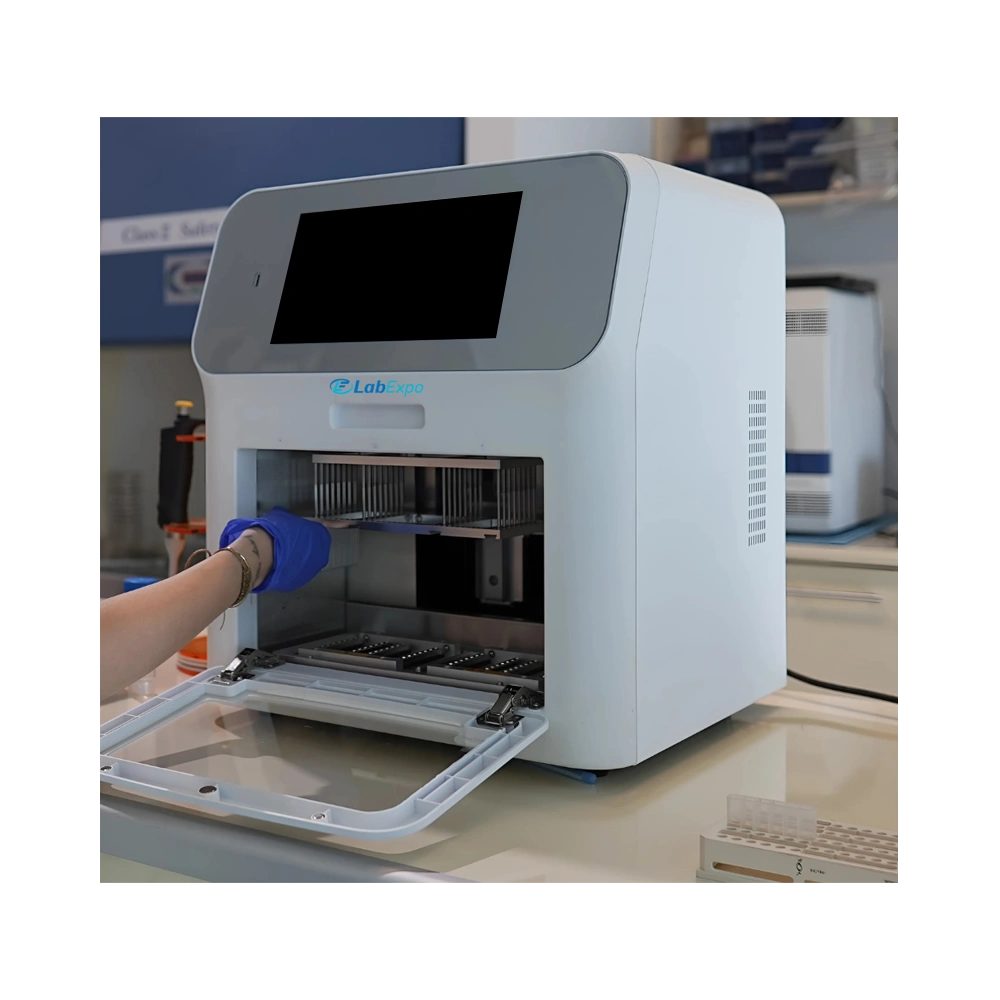
At Lab Expo we developed efficient Nucleic Acid Purification System that offers a compelling balance between automation, speed, and cost-effectiveness, suitable for highly productive operation in labs without investing in costly equipment.
Key Features:
Ideal for Small to Medium Workloads- Whether running just a single sample or up to 20 at a time, this compact benchtop system is designed to fit smoothly into any lab environment. It is perfect for research teams that do not need high-throughput systems but still want reliable performance.
Managing Wide Range of Sample Volumes- Flexibility is at the heart of this machine. It can process sample volumes from as little as 50 µL up to 5 mL—making it suitable for both small-scale experiments and larger extraction needs without switching devices.
Fast Turnaround- Time is critical in the advanced research laboratories. Depending on sample type, it can complete a full purification cycle in just 15 to 40 minutes, helping you move forward quickly with downstream applications.
Inherent UV Protection for Clean Results- Cross-contamination can be a major setback in nucleic acid work. That is why this system includes an integrated UV lamp that disinfects the working area between runs—so every sample starts in a clean environment.
High Recovery and Purity- You can count on excellent results, even from small or delicate samples. The system achieves over 95% nucleic acid recovery, ensuring high-quality output that is ready for PCR, sequencing, or other molecular workflows.
Simple Touchscreen Operation- The intuitive 7-inch colour touchscreen makes it easy to set up and monitor your protocols. You can save, edit, and run over 100 different methods—no need to reprogram from scratch every time.
Easy to use Features- From magnetic bead-based mixing and easy-start shortcuts to built-in alerts and emergency stop functions, the system is built to simplify your workflow. It even includes proper ventilation to ensure safe and consistent operation.