Request Quote
Scan the QR code below to connect with us on WhatsApp.

Request Quote
Scan the QR code below to connect with us on WhatsApp.
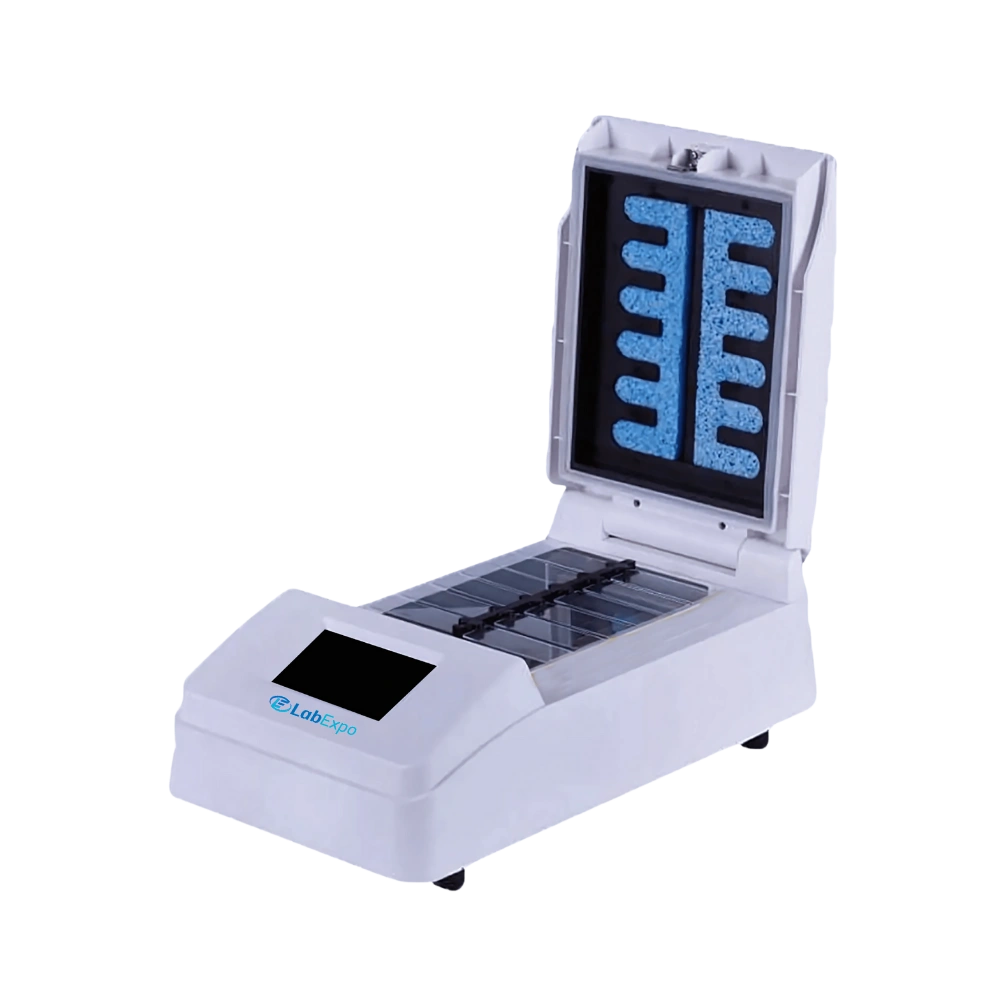
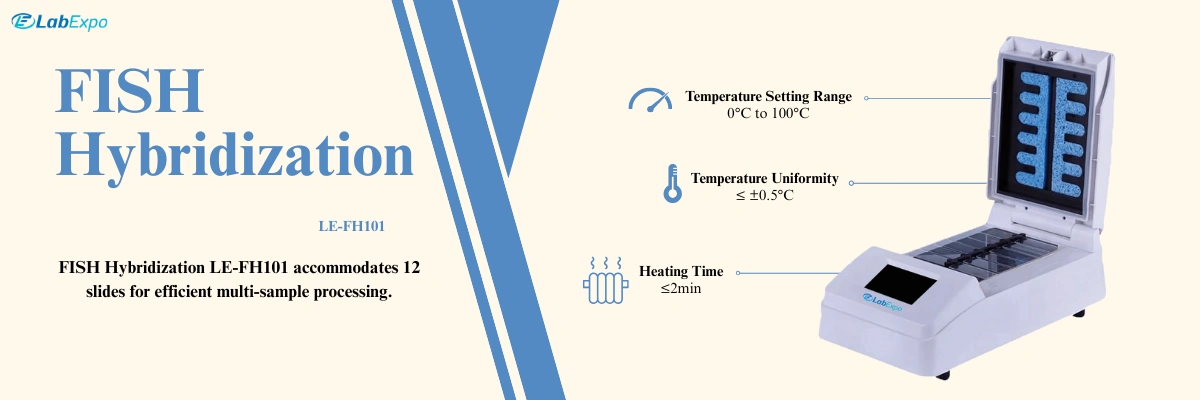
FISH Hybridization LE-FH101 accommodates 12 slides for efficient multi-sample processing. It supports 300 custom program storage options to support diverse protocols. Equipped with a responsive touch screen interface for intuitive control and easy parameter adjustments. Our FISH Hybridization delivers reliable, user-friendly and efficient performance for advanced molecular diagnostics.
Specifications
| Capacity | 12 Samples |
| Temperature Control Range | RT+5°C to 100°C |
| Temperature Setting Range | 0°C to 100°C |
| Temperature Accuracy | ≤ ±0.5°C |
| Temperature Uniformity | ≤ ±0.5°C |
| Time Range | 1min to 99h 59min |
| Heating Time | ≤2min |
| Cooling Time | ≤6min |
| Power Consumption | 350W |
| Power Supply | AC220V/110V, 50/60Hz |
| Dimension | 440 × 220 × 120mm |
| Weight | 4.5 Kg |
Features
Applications
FISH Hybridization LE-FH101 is extensively utilized in cytogenetics, cancer diagnostics, microbial identification, prenatal screening, gene mapping and chromosomal disorder detection by enabling precise visualization and localization of specific nucleic acid sequences within cells and tissues using fluorescent probes.

1: Which applications can the FISH Hybridization system be used for?
It is widely applied in cytogenetics, cancer diagnostics, prenatal testing, microbial identification, gene mapping, and chromosomal disorder studies.
2: How many samples can be processed in a single run?
Our FISH Hybridization unit can accommodate up to 12 slides simultaneously, ensuring efficient multi-sample workflows.
3: What makes this system user-friendly for routine laboratory use?
They are equipped with a touch screen interface, customizable programs, and quiet operation, simplifying daily lab work.
4: Which temperature control features ensure reliable hybridization results?
These systems provide precision temperature regulation with ±0.5°C accuracy and uniform heat distribution, ensuring consistent performance.
5: How does the equipment support protocol flexibility?
Their storage capacity of 300 customizable programs allows researchers to adapt workflows to various diagnostic and research needs.
6: Why is temperature flexibility important in FISH Hybridization?
Temperature flexibility allows the protocol to be tailored for various tissue types and probe sensitivities, ensuring optimal hybridization efficiency and signal specificity.
7: What are the advantages of a high-resolution touchscreen interface in a FISH Hybridization System?
A high-resolution touchscreen enhances usability by providing intuitive access to settings, real-time monitoring and easy navigation through multiple hybridization steps and protocol options.
8: Can FISH hybridization systems be used for cancer screening applications?
Yes. These systems are specifically designed to support slide preparation and probe hybridization for detecting chromosomal abnormalities associated with various cancers such as breast, lung, bladder and cervical cancers.
9: What type of gene mapping applications can these systems support?
They are ideal for gene localization, structural analysis, chromosomal translocation detection, and aneuploidy studies, aiding in both basic research and clinical diagnostics.
10: Why is temperature precision critical for FISH Hybridization System?
Maintaining precise temperature control is essential for ensuring consistent, reliable hybridization outcomes particularly critical in clinical diagnostic settings where accuracy is paramount.
Lab Expo FISH Hybridization accommodates a broad temperature range for different tissues and probe types. They are integrated with a high-resolution touchscreen interface that allows users to easily configure, monitor and store multiple hybridization protocols. These are equipped to handle slide preparations for applications in cancer screening and gene mapping. Our FISH Hybridization is designed to meet the rigorous demands of modern laboratories with temperature precision and operational speed.
