Request Quote
Scan the QR code below to connect with us on WhatsApp.

Request Quote
Scan the QR code below to connect with us on WhatsApp.

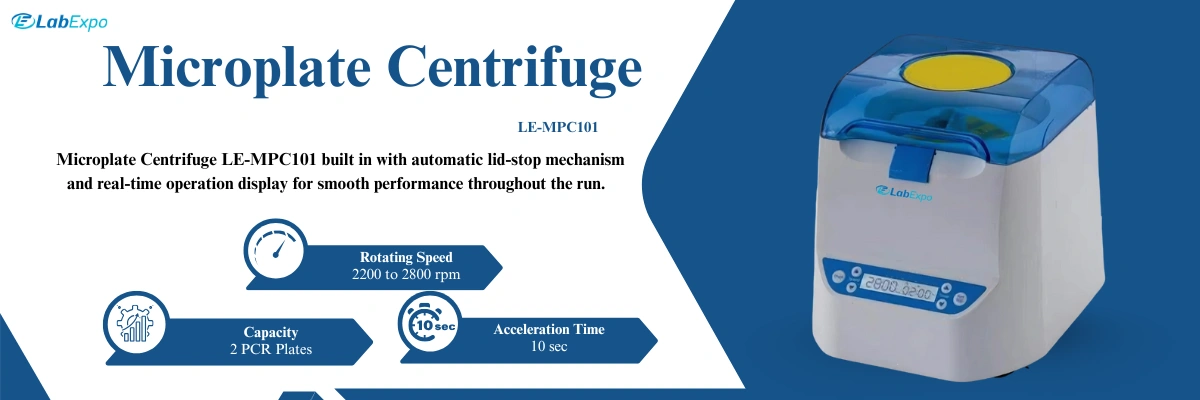
Microplate Centrifuge LE-MPC101 delivers a rotating speed range of 2200 to 2800 rpm, enabling rapid sample separation. It is equipped with dual PCR plate capacity for high-throughput workflows. Built in with automatic lid-stop mechanism and real-time operation display for smooth performance throughout the run. Our Microplate Centrifuge ensures reliable results in demanding laboratory environments.
Specifications
| Rotating Speed | 2200 to 2800 rpm |
| Capacity | 2 PCR Plates |
| Time Range | 15 sec to 1min 59 sec |
| Acceleration Time | 10 sec |
| Power Consumption | 45W |
| Power Supply | AC 110 to 220 V, 50/60 Hz |
| Dimension | 260 × 240 × 226 mm |
| Weight | 3.3 Kg |
Features
Applications
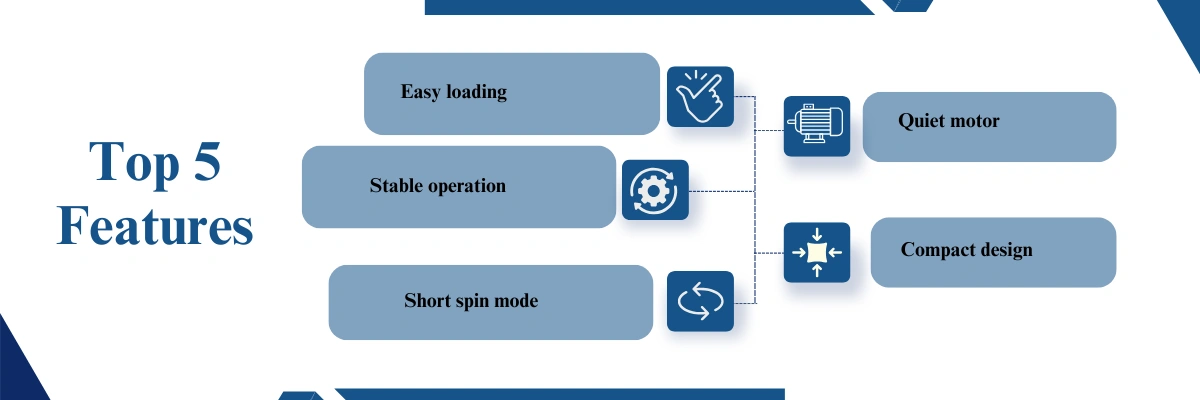
Function Implementation High-throughput plate processing Rapid segregation of microplate contents without manual effort Sample protection Soft motion minimizing well spillover and cross-contamination Routine workflow efficiency Intuitive digital control for repeatable run cycles Safety assurance Load imbalance detection preventing hardware stress Quiet lab environment Low acoustic footprint suitable for busy benches
1: How does this centrifuge support PCR workflows?
These centrifuges are designed with dual PCR plate capacity, allowing simultaneous processing of two plates for faster sample preparation.
2: What safety features are included in this model?
Their automatic lid-stop mechanism ensures user safety by halting operation immediately if the lid is opened during use.
3: Is this centrifuge suitable for quick separations?
They operate at speeds between 2200 to 2800 rpm with short acceleration times, making them ideal for rapid spin-downs.
4: How is performance monitored during operation?
It features a real-time operation display that provides clear status updates throughout each run.
5: Why is this centrifuge beneficial for laboratory settings?
Our Microplate Centrifuge combines compact size, fast processing, and safe operation, making it a reliable tool for high-throughput laboratory applications.
6: How does rapid acceleration or deceleration benefit laboratory workflows?
Faster ramp-up and spin-down times significantly reduce total cycle duration, enabling quick plate processing and supporting time-sensitive experiments or high-throughput workflows.
7: What is over-speed detection, and why is it important?
Over-speed detection monitors rotor speed in real time and prevents the centrifuge from exceeding its maximum rated RPM. This protects both the user and the device from potential mechanical failure.
8: How does the door cover protection system work?
The Centrifuge will not begin operation unless the lid is securely closed. During operation, the lid remains automatically locked and only unlocks when the rotor comes to a complete stop, preventing accidental opening.
9: What information is displayed on the LCD screen during operation?
The LCD screen shows real-time data, including run time, rotor speed i.e. RPM or RCF, program status and safety alerts, allowing users to monitor and manage the process efficiently.
10: What makes the Centrifuge user-friendly?
The Centrifuge features intuitive controls, a clear LCD display, quick-lock rotor systems and easily accessible settings that simplify operation, even for first-time users.
Lab Expo Microplate Centrifuge supports high-throughput centrifugation workflows where simultaneous processing of multiple plates and rapid cycle transitions are required. This centrifuge microplate system operates with digitally regulated speed and time control to manage parallel runs efficiently. Rapid acceleration and deceleration reduce turnaround time, while integrated safety features such as lid protection, overspeed detection, and imbalance monitoring ensure controlled, repeatable operation for routine laboratory processing.
